Cracked Window Repair: Types, Causes and When to Replace It
A cracked window is one of those problems that's easy to put off. It looks minor, life gets busy, and it stays on the to-do list. The trouble is that most cracks don't stay minor for long, and what could have been a straightforward glass repair can turn into a much bigger mess if you leave it.
But before you call anyone, it helps to understand what kind of crack you're actually dealing with. Not all cracks are the same, and the type of crack tells you a lot about what caused it, how urgent it is, and what needs to happen next.
The Three Types of Window Cracks (And What Each One Means)
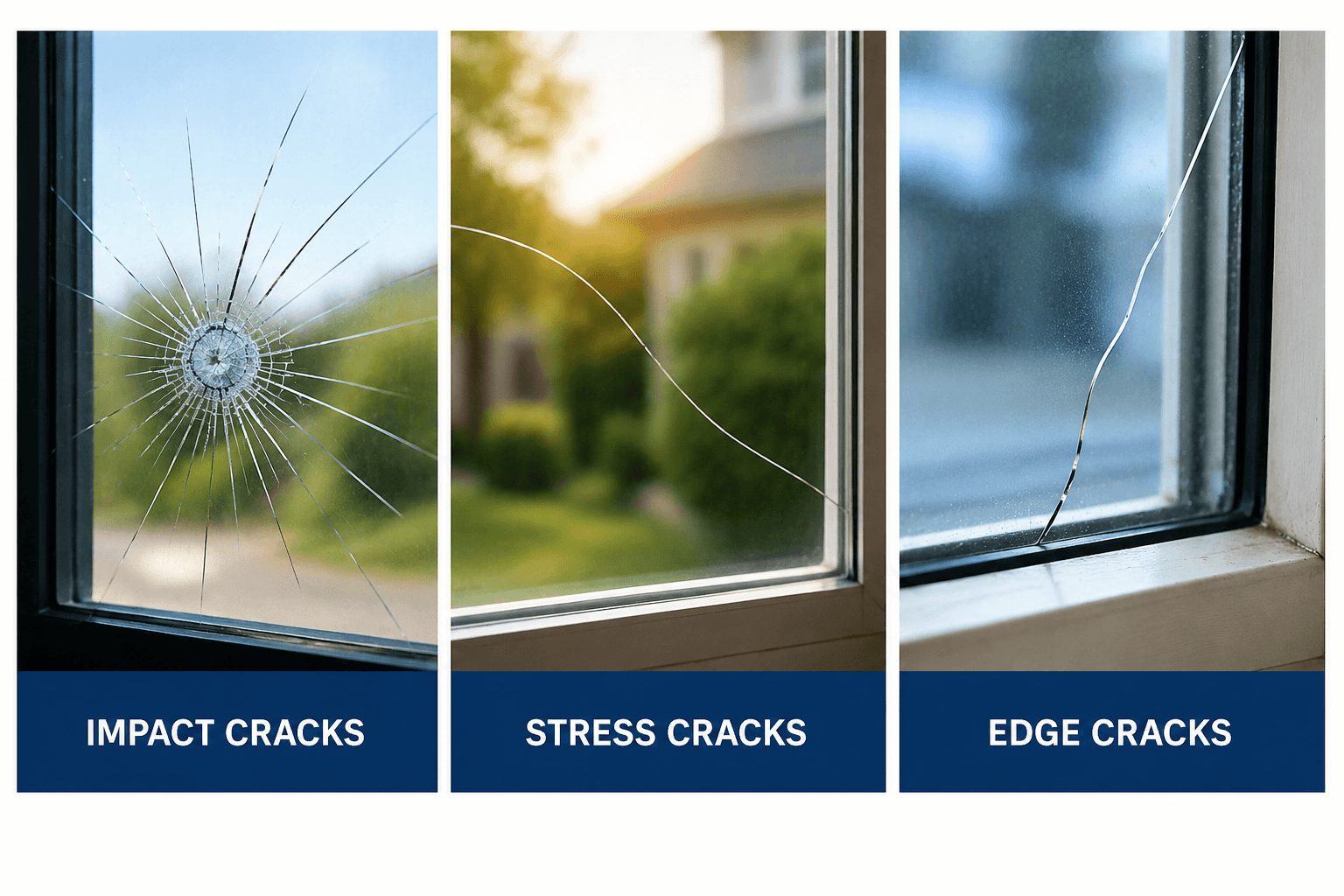
Impact Cracks
A cracked window is one of those problems that's easy to put off. It looks minor, life gets busy, and it stays on the to-do list. The trouble is that most cracks don't stay minor for long, and what could have been a straightforward glass repair can turn into a much bigger mess if you leave it.
But before you call anyone, it helps to understand what kind of crack you're actually dealing with. Not all cracks are the same, and the type of crack tells you a lot about what caused it, how urgent it is, and what needs to happen next.
Stress Cracks
Stress cracks are the ones that confuse people most because they appear with no obvious cause. You wake up one morning and there's a crack in a window nobody has touched.
These happen when different parts of the glass expand or contract at different rates. The edge of a pane is often cooler than the centre, particularly in windows that get direct sun. When the centre heats up and expands while the edges stay cool and rigid, the tension across the glass builds until it cracks.
Stress cracks have a distinctive look once you know what you're looking for. They typically start at the edge of the pane, run perpendicular to the frame for a short distance, then curve or run diagonally across the glass. They rarely start in the middle of a pane. There's no impact point, no chip, just a clean-looking crack that seems to come from nowhere.
On the Central Coast, thermal stress cracks are more common than most people realise. Western and northern facing windows that cop strong afternoon sun are particularly vulnerable, especially in summer when the temperature swings between cool mornings and hot afternoons are significant. Coastal conditions add to this because the combination of direct sun, salt air, and temperature variation puts more stress on glass and frames than inland areas experience.
Edge Cracks
Edge cracks start at the very edge of the glass, often within 5 to 10mm of the frame. They can look like stress cracks, and sometimes they are. But edge cracks can also result from poor original installation where the glass was sitting under pressure from the frame, or from frame movement over time as the house settles.
Older homes on the Central Coast, particularly those built in the 1970s and 1980s, often have timber frames that have moved considerably over the decades. As frames shift, they can put direct pressure on the glass edges. The result is a crack that appears slowly and gets worse gradually rather than appearing all at once.
Edge cracks are worth taking seriously because they tend to spread. Once a crack starts running from the edge it has a clear path across the pane.
What Does It Look Like When a Crack Is Spreading?
This is useful to know if you're trying to decide whether to act now or in a few days.
A crack is actively spreading when you can see it getting longer between observations, when new branches or offshoots appear from the main crack, or when you hear a faint ticking or cracking sound from the window, particularly during temperature changes early morning or late afternoon.
A stable crack will stay the same length and shape for days or weeks. A spreading crack often moves in response to temperature. You might notice it looks different on a hot afternoon compared to a cool morning.
The practical test: mark both ends of the crack lightly with a marker or a small piece of tape, and check it again in 24 to 48 hours. If it has moved past your marks, it's spreading and needs to be dealt with promptly.
Can Any Cracked Window Actually Be Repaired?
Rarely, and usually only as a temporary measure.
Very minor edge chips in standard float glass can sometimes be stabilised by a glazier to buy time before a full replacement. This is not a permanent fix, it's a way to stop a small problem becoming a bigger one while you arrange the proper repair.
For everything else, replacement is the answer. This includes any crack that is spreading, any crack in toughened or laminated glass, and any crack that affects a door, a low-level window, or any glass that children or pets can access.
The key point people miss is that a crack doesn't need to be large to require replacement. A 30mm crack in toughened glass means the entire pane needs to go, the same as a fully shattered one. Toughened glass cannot be repaired under any circumstances. Once the structure is compromised, it has to be replaced.
Why Does the Type of Glass Matter So Much?
Because it completely changes what happens next. For a full breakdown of repair costs and service types across all glass situations, see our Central Coast glass repair guide.
Standard float glass is what older Central Coast homes typically have. It breaks into large, sharp shards, which is why it has largely been replaced by safer alternatives in modern builds. It's the easiest and cheapest glass to replace, and small damage can occasionally be temporarily managed while you arrange a replacement.
Toughened safety glass is now required by Australian Standards (AS 1288) in any glazing that's considered high-risk. That means sliding doors, shower screens, any glass within 300mm of a door, windows within 500mm of the floor, and stair areas. It's designed to shatter into small blunt pieces rather than sharp shards. Once it's cracked, it cannot be repaired and the full pane must be replaced. If your home has been built or renovated since the mid-2000s, you likely have toughened glass in more places than you'd expect.
Laminated glass is two layers of glass bonded together with a plastic interlayer. When it breaks, the interlayer holds the pieces together rather than letting them fall. It's used for security glazing, noise reduction, and some architectural applications. Even though a cracked laminated pane often stays in one piece, replacement is still required because the structural and acoustic performance is gone.
Double glazed units are two separate panes sealed together with a gas-filled cavity between them. If one pane cracks, or if you notice fogging or condensation between the panes (which means the seal has failed), the whole unit needs to be replaced. You can't repair or reseal a failed double glazed unit from the outside.
Does Window Film Help With a Cracked Window?
This comes up a lot and the answer is: only as a very short-term safety measure.
Safety film applied over a cracked window can help hold the glass together temporarily and reduce the risk of shards falling if the crack progresses. It's not a repair, and it won't stop the crack spreading, but it can make the window safer to be around while you're waiting for a glazier.
It's worth doing on a cracked low-level window or door panel if there are kids or pets in the house and you're waiting a day or two for the repair. It's not a solution, but it's a reasonable precaution.
Don't use standard tape. It doesn't hold glass effectively, looks terrible, and gives a false sense of security.
Is a Cracked Window Dangerous?
Yes, more than it looks.
A crack significantly weakens glass even when the pane is still intact. A window that survived years of storms can fail suddenly once a crack is present, because the structural load is no longer distributed evenly across the pane. Wind pressure, vibration from a door, or a temperature change can be enough to shatter it without any additional impact.
The specific risks are exposed sharp edges if the glass does fail, water getting into the frame and causing damage over time, compromised security because a cracked pane is much easier to push through, and for toughened glass, the risk of sudden full shattering rather than a contained break.
Windows near doors and low-level windows are the highest priority. They're in higher-traffic areas, they're more likely to be contacted accidentally, and in most cases they're required by law to contain toughened glass.
How Much Does Replacing a Cracked Window Cost?
It depends on the glass type, the size of the pane, the accessibility of the window, and whether the glass needs to be custom ordered rather than cut from stock.
As a rough guide, a standard float glass pane in a small to medium residential window starts from around $150 to $250. Toughened glass costs more because it has to be manufactured to size and cannot be cut on site. Double glazed units are more expensive again because they're sealed at the factory and need to be ordered to the specific dimensions of your window.
Emergency or after-hours callouts carry an additional fee on top of the replacement cost.
The honest answer is that a quote from someone who can actually see the window will be far more accurate than any figure you find online. Glass pricing varies with size, and there's a significant difference between a small bathroom window and a large living room pane even within the same glass type.
What to Do Right Now If Your Window Is Cracked
Keep people and pets away from the area. Don't touch or press on the glass to test it. Avoid slamming nearby doors, which creates vibration that can spread a crack quickly.
If there are loose fragments or the pane has partially collapsed, don't vacuum up toughened glass without eye protection as fragments can fly. Don't try to remove large shards by hand without thick gloves.
Apply safety film as a short-term measure if the window is in a high-risk location and there's a delay before a glazier can attend. Mark the ends of any crack so you can track whether it's spreading.
Then call a glazier. If the break has left your home unsecured or there are exposed sharp edges, treat it as urgent.
Need a Glazier on the Central Coast
North Lakes Glass handles cracked window assessments, glass replacement, and emergency repairs across the Central Coast and Lake Macquarie. Whether you have a stress crack that appeared overnight, impact damage, or a fully shattered pane, we can tell you what you're dealing with and get it sorted.
Same-day service is available for most jobs. 24-hour emergency repairs are available when you need someone now.
Call us on 0400 395 578 and we'll give you a straight answer on what needs to happen and what it'll cost.